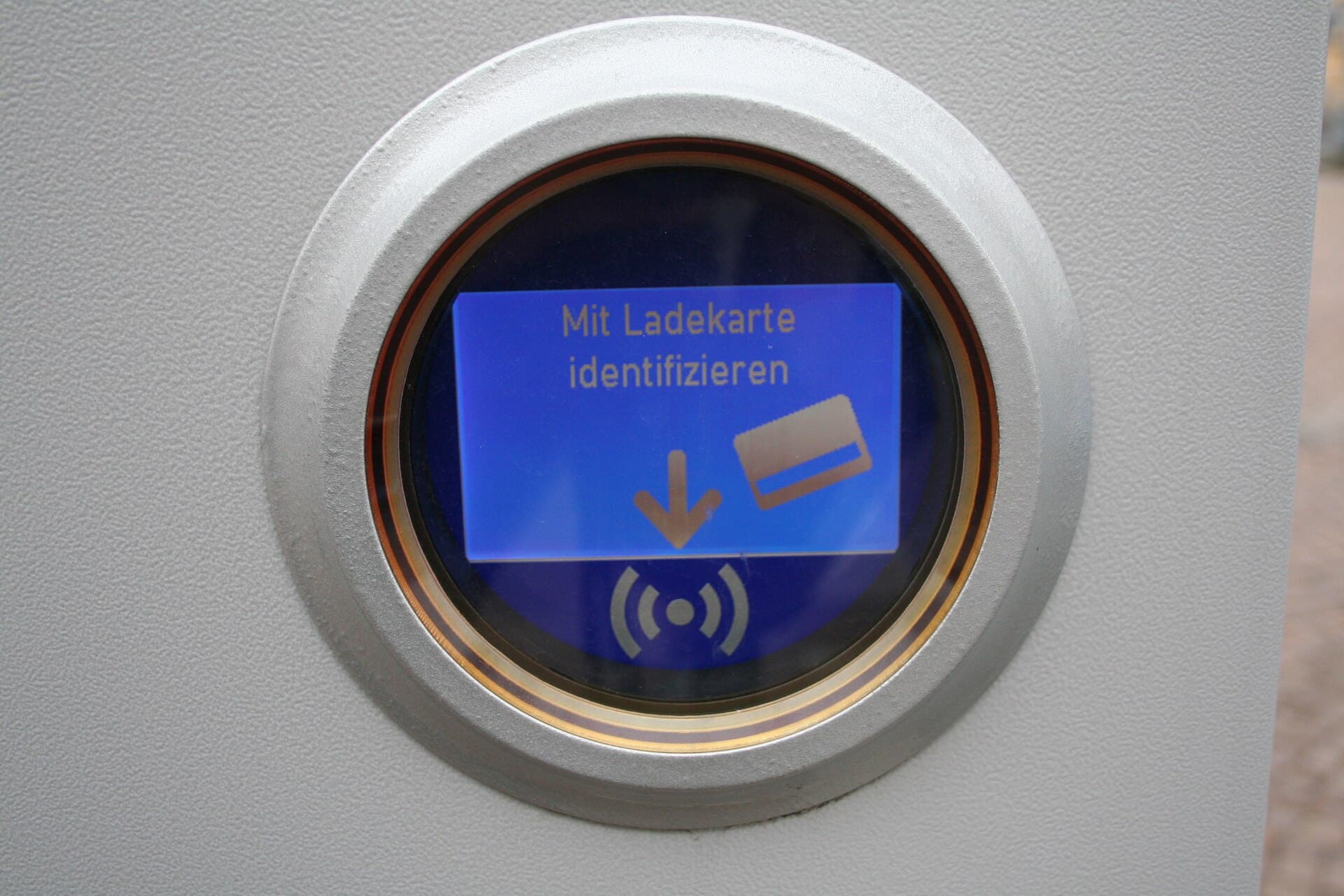
Photo: Baranekstuttgart (CC BY-SA 3.0)
Comparison
EV Charging Cards in Europe: Which One to Choose in 2026?
October 6, 2026
By Hugo Beignon, Founder of ma-borne-electrique.com
Four multi-network charging cards compared on the same criteria, using only the figures their issuers publish: coverage, countries, fixed cost and fees.
A multi-network charging card lets you start and pay for a charge on many operators' chargers with a single account. No card is the best everywhere: the right choice depends on the countries you cross. For a trip through several countries, we advise taking two cards from different issuers and a bank card as a backup.
Which charging card should you choose? The short answer
- You travel a few times a year: choose a card with no subscription, so you only pay for your charges.
- You cross several countries: check that each country is on the card's list, and take a second card from another issuer.
- You are going to the United Kingdom: check the country list. EnBW mobility+, for example, does not cover the United Kingdom.
- You often charge on the same rapid network: compare that network's subscriptions instead.
Four multi-network charging cards compared
The figures below are the ones each issuer publishes on its own website, checked on 6 October 2026. The cards are listed in alphabetical order. The stated number of charge points says little about your own trip: check in the card's app that the chargers on your route are compatible.
| Card | Stated coverage | Countries | Fixed cost and fees |
|---|---|---|---|
| Chargemap Pass | More than 2,000 networks | 19 European countries | 14.90 euros to buy as a limited offer (19.90 euros otherwise), no subscription. Service fees apply, except with the Chargemap Boost subscription |
| Electromaps | More than 430,000 public charge points | List not published on the page we checked | Charging through the app or with the Electropass key fob |
| EnBW mobility+ | More than 900,000 charge points | 17 countries, not the United Kingdom | Three tariffs (S, M, L). At other operators, 0.56 to 0.89 euros per kWh depending on the operator |
| Octopus Electroverse | More than 1.4 million charge points, more than 1,300 networks | United Kingdom and Europe | Free card, no subscription or transaction fees |
We do not quote per-kWh prices for each card, apart from the range EnBW publishes: those prices depend on the charger, and the comparisons we consulted contradict each other. The price that matters is the one the app shows for the charger where you stop.
Charging card or bank card: do you still need a charging card?
In the European Union, the AFIR regulation requires a bank card reader or contactless payment on public chargers of 50kW or more deployed since 13 April 2024. Chargers of 50kW or more installed before that date on the trans-European road network must be equipped from 1 January 2027.
A charging card is still worth having in two cases. On chargers below 50kW, the regulation allows payment by QR code instead of a card reader. And chargers of 50kW or more installed before 13 April 2024 are under no such obligation before 2027. Always compare the price shown in the app with the one displayed on the charger.
Which charging card for each country
- Belgium: the European regulation applies. EnBW mobility+ lists Belgium among its 17 countries.
- France: the European regulation applies. EnBW mobility+ lists France among its 17 countries.
- Germany: the European regulation applies. EnBW mobility+ lists Germany among its 17 countries.
- Spain: the European regulation applies. EnBW mobility+ lists Spain among its 17 countries.
- Switzerland: the European regulation does not apply there. EnBW mobility+ lists Switzerland among its 17 countries.
- United Kingdom: UK regulations require contactless payment on new chargers of 8kW or more and on rapid chargers of 50kW or more. Octopus Electroverse covers the country, EnBW mobility+ does not.
For the Chargemap Pass, Electromaps and Octopus Electroverse, check the country list on the issuer's website before you leave. Our country guides cover plugs, prices and driving rules for each of these six countries.
Multi-network card or a single network's subscription?
They are two different products. A multi-network card gives access to many operators' chargers with a single account. A network's subscription applies to that network's chargers, for a monthly amount. Some cards offer both: EnBW mobility+ comes in three tariffs, and Chargemap sells the Boost subscription, which removes the service fees.
Before you leave
- Order the card in advance, to allow for postal delivery.
- Install the card's app and save a payment method.
- Check in the app that the chargers on your route are compatible.
- Keep a contactless bank card as a backup.
Frequently asked questions
What is the best EV charging card for Europe?
No card is the best everywhere. Octopus Electroverse states more than 1.4 million charge points, EnBW mobility+ more than 900,000 in 17 countries, Electromaps more than 430,000, and the Chargemap Pass more than 2,000 networks in 19 countries. The right choice depends on the countries you cross.
Do you still need a charging card in 2026?
Less than before on recent rapid chargers: in the European Union, chargers of 50kW or more deployed since 13 April 2024 must accept bank cards. A charging card is still useful on chargers below 50kW and on older rapid chargers.
Do EV charging cards cost money?
It depends on the issuer. Octopus Electroverse says it charges nothing for the card, no subscription and no transaction fees. The Chargemap Pass costs 14.90 euros to buy as a limited offer (19.90 euros otherwise), with no subscription, and service fees apply except with the Chargemap Boost subscription.
Does one charging card work across all of Europe?
Not necessarily. EnBW mobility+ covers 17 countries, not the United Kingdom, and the Chargemap Pass 19 European countries. Check the country list and the chargers on your route before you leave.
What is the difference between a charging card and a charging subscription?
A multi-network card gives access to many operators' chargers with a single account. A network's subscription applies to that network's chargers, for a monthly amount.
Read also
- EV Charging Subscriptions: Comparing the Real Cost of Charging in France in 2026
- Driving an Electric Car in France: Charging, Cards and Prices
- Driving an Electric Car in Germany: Charging, Payment and Prices
- Driving an Electric Car in Spain: Charging, Payment and Prices
- Driving an Electric Car in the UK: Charging, Payment and Prices
- Driving an Electric Car in Switzerland: Charging, Vignette and Prices
- Driving an Electric Car in Belgium: Charging, Payment and Prices
- Charging stations by region: station counts, fast charging and best-covered towns
- EV charging guide by model: power, times and costs (Tesla, Renault, Peugeot...)
- National EV charging barometer: reliability and uptime by network
Want to find a charging station nearby? Check the charging map to plan your next trip.