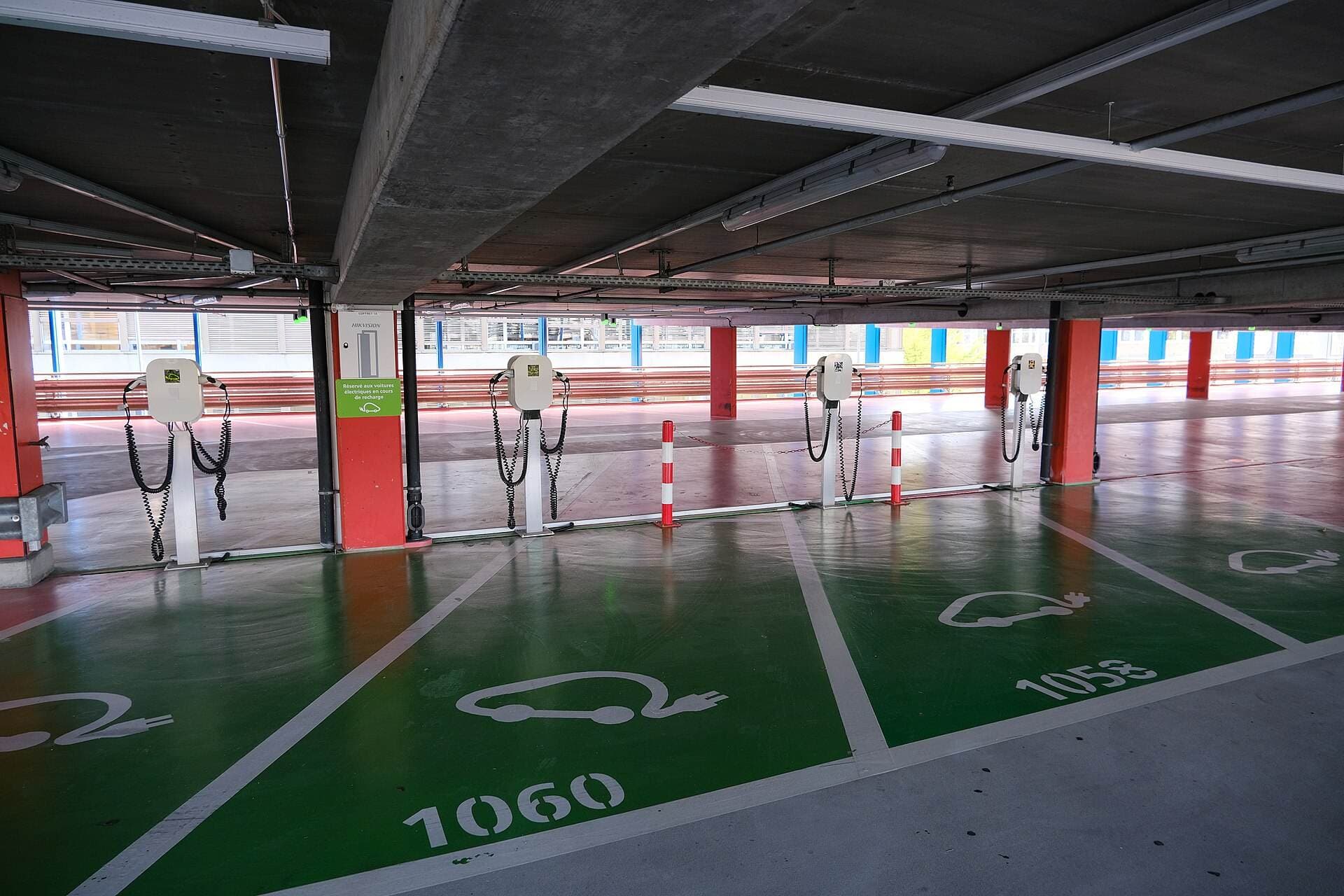
Photo: Guilhem Vellut (CC BY 2.0)
Travel
Driving an Electric Car in Switzerland: Charging, Vignette and Prices
October 1, 2026
By Hugo Beignon, Founder of ma-borne-electrique.com
Plugs, paying outside the EU, prices in Swiss francs, the motorway vignette and a different household socket: a practical guide to charging in Switzerland.
Switzerland had 18,284 public charging points across 8,535 locations in April 2026, according to the Swiss Federal Office of Energy. The network is well spread, including on the main Alpine routes. For a visitor, Switzerland has three quirks: it is not part of the European Union, motorways require a vignette, and the household socket differs from its neighbors'.
Your plug fits, your backup cable may not
Swiss chargers use the European standard: the Type 2 connector for AC charging and the CCS2 combo connector for DC fast charging. Pack your Type 2 cable, since many AC stations do not supply one. The Swiss household socket (type J, known as T13) does not accept the type E/F (Schuko) plugs used in France or Germany, so a portable charging cable only fits with an adapter designed for that use.
Paying outside the European Union
The EU's AFIR regulation, which requires bank card payment at new fast chargers inside the Union, does not apply in Switzerland. In practice, recent fast chargers on the big networks often accept contactless payment, and others are paid by QR code, app or charging card. Many European charging cards roam in Switzerland, but check before you leave. Watch your mobile plan too: Switzerland is often excluded from EU roaming, so install and activate your apps before you cross the border.
What a charge costs in Switzerland
Prices are shown in Swiss francs. Fast charging generally costs 0.65 to 1 franc per kWh, and can reach about 1.25 francs at ultra-fast stations. At 0.80 francs per kWh, a compact EV using about 16 kWh per 100km costs around 12.80 francs per 100km. Paying with a foreign bank card may add exchange fees, so check with your bank.
The motorway vignette and local rules
The motorway vignette is mandatory for electric cars just like any other. It costs 40 francs, and the 2026 vignette is valid until January 31, 2027. The electronic version, linked to your plate, is sold on the official portal of the Federal Office for Customs and Border Security (via.admin.ch), so beware of sites that resell it at a markup. In Geneva, the Stick'AIR sticker only matters during pollution peaks, when electric cars are still allowed to drive, and the French Crit'Air sticker is recognized there.
Finding a charger along your route
The map on ma-borne-electrique.com locates chargers in Switzerland using Open Charge Map data, which can be incomplete. In the mountains, keep a margin: cold reduces range and long climbs use a lot of energy, even if descents give some back through regenerative braking. Check real-time availability in a route-planning app before you detour.
Checklist before you leave
- Check your connector (Type 2 or CCS2) and pack your Type 2 cable.
- Buy the motorway vignette on the official via.admin.ch portal.
- Install and activate your charging apps before the border, in case your mobile plan does not cover Switzerland.
- Bring a bank card without foreign exchange fees to pay in Swiss francs.
- In the mountains, keep a bigger range buffer than on the flat.
Frequently asked questions
Does an electric car need a motorway vignette in Switzerland?
Yes. The vignette is mandatory for all cars, electric ones included. It costs 40 francs, and the 2026 vignette is valid until January 31, 2027. The electronic version is sold on the official via.admin.ch portal.
Can I pay by bank card at Swiss chargers?
Often at recent fast chargers, but it is not a legal requirement as it is in the EU. Have a compatible app or charging card ready, installed before you cross the border.
How much does fast charging cost in Switzerland?
Generally 0.65 to 1 Swiss franc per kWh, up to about 1.25 francs at ultra-fast stations. For a compact EV, that is around 12.80 francs per 100km at 0.80 francs per kWh.
Will my portable charging cable work in Switzerland?
Not directly. The Swiss household socket (type T13) does not accept the type E/F (Schuko) plugs used in France and Germany, so you need an adapter designed for charging. At charging stations, your Type 2 cable works as usual.
Read also
- Driving an Electric Car in France: Charging, Cards and Prices
- Driving an Electric Car in Germany: Charging, Payment and Prices
- Driving an Electric Car in Belgium: Charging, Payment and Prices
- Driving an Electric Car in Spain: Charging, Payment and Prices
- Driving an Electric Car in the UK: Charging, Payment and Prices
- EV Charging Cards in Europe: Which One to Choose in 2026?
- Charging stations by region: station counts, fast charging and best-covered towns
- EV charging guide by model: power, times and costs (Tesla, Renault, Peugeot...)
- National EV charging barometer: reliability and uptime by network
Want to find a charging station nearby? Check the charging map to plan your next trip.