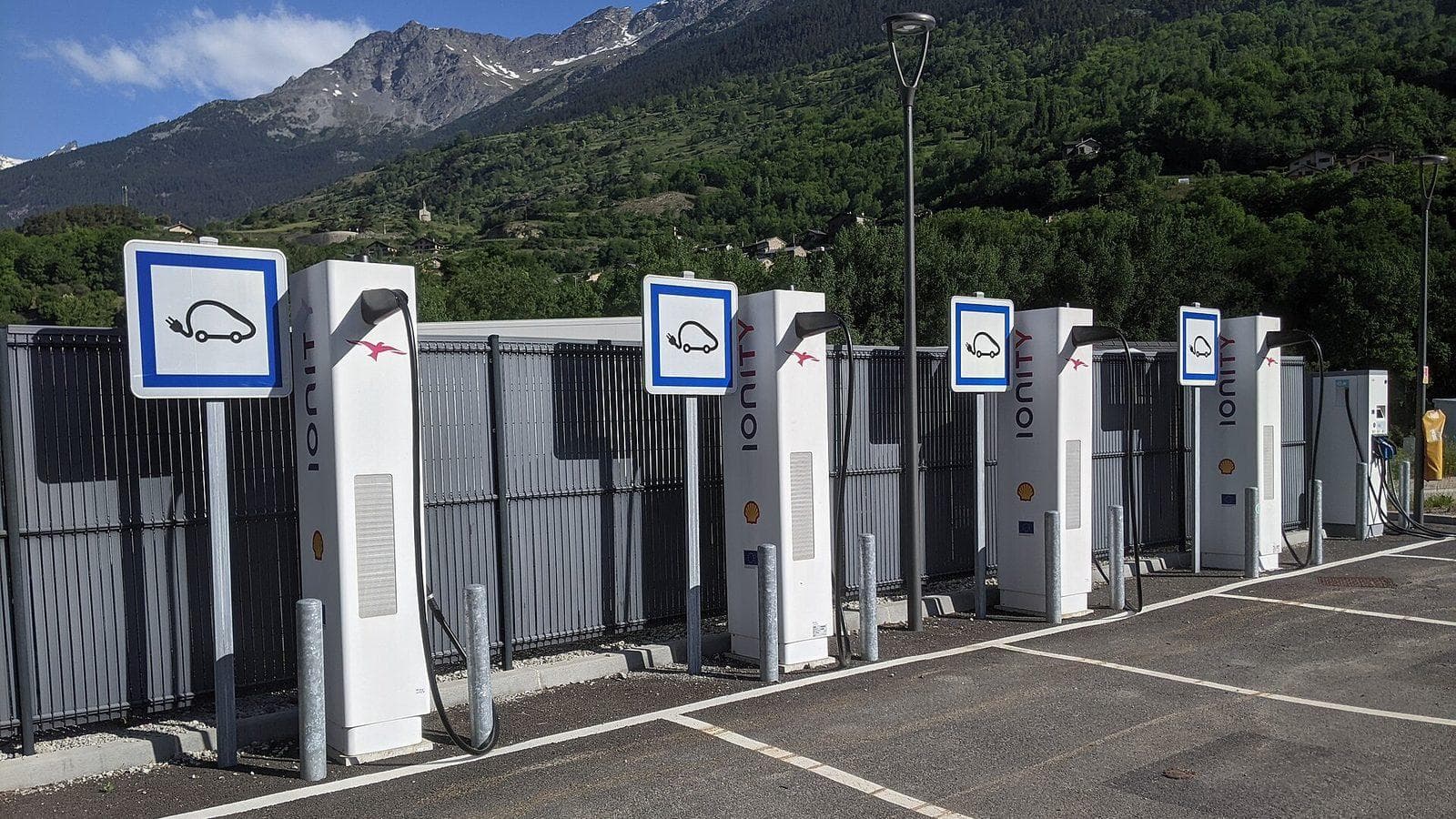
Photo: Sebleouf (CC BY-SA 4.0)
Travel
Driving an Electric Car in France: Charging, Cards and Prices
September 21, 2026
By Hugo Beignon, Founder of ma-borne-electrique.com
Which plug fits, how to pay without a French account, what a charge costs and which sticker to order before you cross the border: a practical guide for visitors.
With more than 200,000 public charging points, France is easy to cross in an electric car. For a visitor, the real difference from home is less the plug than the payment and the paperwork. Here is what to sort out before you cross the border.
Your plug already fits
France follows the European standard: the Type 2 connector for AC charging and the CCS2 combo connector for DC fast charging. Many AC stations only provide the socket, not the cable, so pack your own Type 2 charging cable. A household socket delivers only about 2.3 kW, which makes it a last resort rather than a real way to charge.
How to pay when you have no French account
Three options exist. You can pay by bank card at fast chargers that have a card reader, use your home country's charging card or app if it roams in France, or go through a French operator's app. Since April 2024, EU rules require public chargers to accept payment without a prior contract, and card readers on fast chargers are being rolled out through 2027, so on an older station expect to need an app or a QR code. Check the price shown before you plug in, because it can differ from what you pay at home.
What a charge costs in France
On a public 22kW station such as Carrefour's, electricity costs 0.23 euros including tax per kWh since August 1, 2026. For a compact EV using about 16 kWh per 100km, that is roughly 3.68 euros per 100km. On the motorway, pay-as-you-go fast charging without a subscription generally costs 0.50 to 0.70 euros per kWh depending on the operator, about three to four times the off-peak rate French households pay at home (0.1589 euros per kWh).
Low-emission zones: order the Crit'Air sticker
French low-emission zones (ZFE) also apply to foreign-registered vehicles. A fully electric car falls into the most favorable Crit'Air category and is not affected by the restrictions, but the sticker has to be ordered in advance, only on the official site certificat-air.gouv.fr, using your plate and first registration date. A provisional certificate arrives by email and the sticker by post within a few days to a few weeks. Checks remain gradual for now, but ordering it removes any doubt before you drive into cities such as Paris, Lyon or Grenoble.
Finding a charger along your route
The map on ma-borne-electrique.com locates chargers, and the regional directory shows the number of stations, the share of fast charging and the best-covered towns for every French department. That data comes from Open Charge Map and can lag behind the official count, so always check real-time availability in a route-planning app before you detour.
Checklist before you leave
- Check your connector (Type 2 or CCS2) and pack your Type 2 cable.
- Activate a charging card or app that works in France, and keep a bank card as a backup.
- Order the Crit'Air sticker on certificat-air.gouv.fr before you go.
- Plan your stops with a route-planning app and note a backup charger for each one.
- On fast chargers, aim for 20% to 80%: charging speed drops beyond that.
Frequently asked questions
Do I need a French charging card to charge my EV in France?
No. Since April 2024, EU rules require public chargers to accept payment without a contract, and fast chargers are gradually being fitted with card readers through 2027. On an older station you may need an app or a QR code.
Will my foreign electric car fit French chargers?
Yes if it uses the Type 2 connector for AC or the CCS2 connector for DC, the European standard. Pack your Type 2 cable, since many stations do not supply one.
How much does it cost to charge in France?
About 0.23 euros including tax per kWh on Carrefour's 22kW stations since August 1, 2026, roughly 3.68 euros per 100km for a compact EV. Motorway fast charging without a subscription generally costs 0.50 to 0.70 euros per kWh depending on the operator, about three to four times the off-peak rate French households pay at home.
Do I need a Crit'Air sticker with a foreign electric car?
French low-emission zones apply to foreign vehicles. An electric car falls into the most favorable category, but ordering the sticker in advance on the official site certificat-air.gouv.fr is advisable.
Read also
- Road-Tripping Through France: How to Charge Your EV Without the Stress
- How Much Does It Really Cost to Charge an Electric Car in France?
- EV Charging Subscriptions: Comparing the Real Cost of Charging in France in 2026
- Low-Emission Zones in France 2026: Where Things Stand After the Constitutional Council's Ruling
- Charging stations by region: station counts, fast charging and best-covered towns
Want to find a charging station nearby? Check the charging map to plan your next trip.