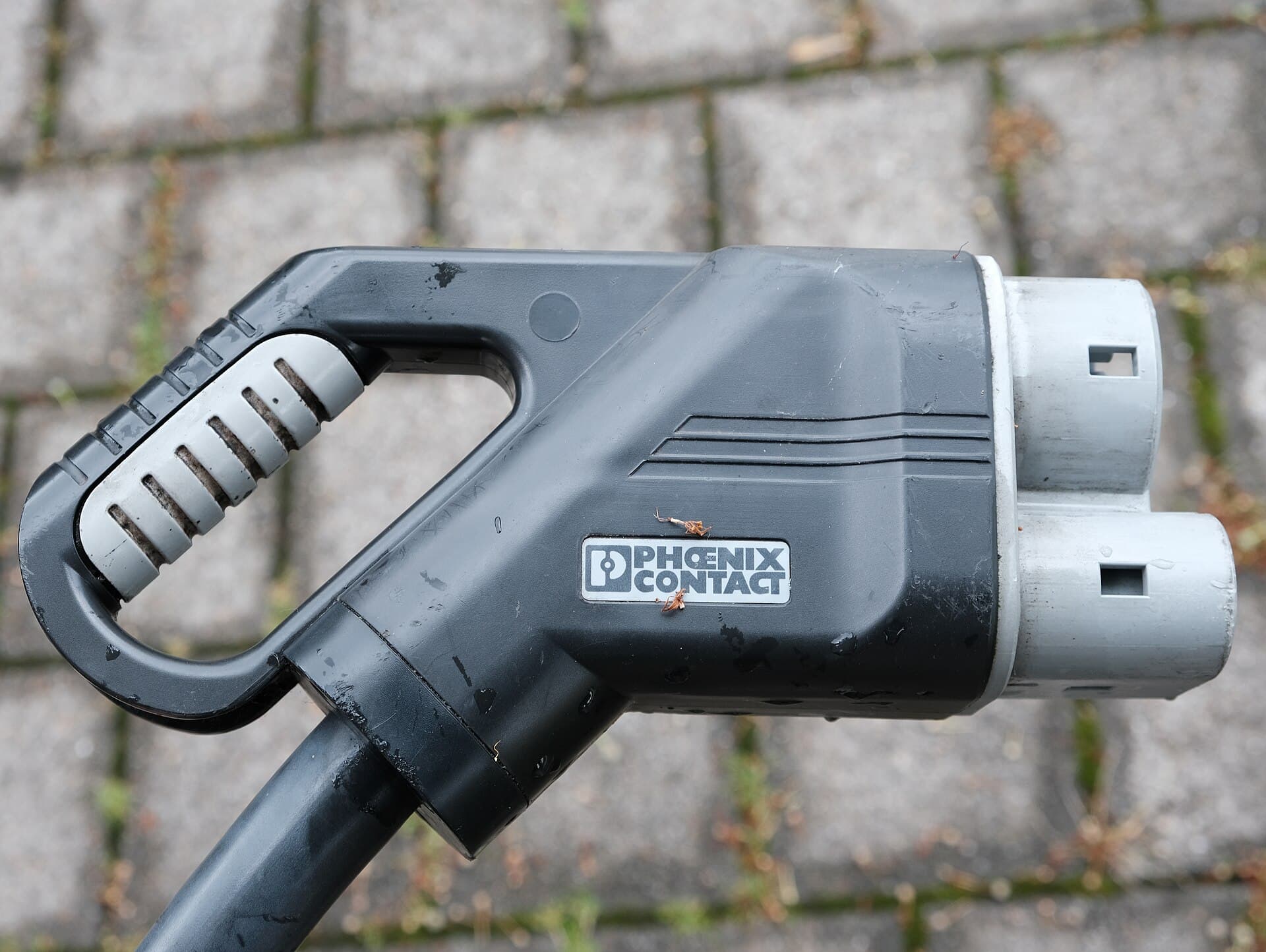
Photo: Danilo Bargen (CC BY-SA 4.0)
Practical guide
Type 2, CCS, CHAdeMO: which connector for your electric vehicle?
August 26, 2026
By Hugo Beignon, Founder of ma-borne-electrique.com
Every charging station offers one or more connector types, each tied to a maximum power output. Here's how to make sense of it before you plug in.
Alternating current (AC) or direct current (DC)?
A charging station delivers either alternating current (AC) or direct current (DC), and this choice directly determines how fast your car can charge. AC charging passes through the vehicle's onboard charger, a built-in component that converts grid power into current the battery can use; this limits the real power output, typically between 3.7 and 22 kW, on Type 2 connectors (IEC 62196 standard). DC charging bypasses the onboard charger entirely: the charger sits inside the station itself and feeds the battery directly, allowing much higher power, from 50 to 350 kW on rapid chargers, using Combo CCS or CHAdeMO connectors. In short: AC suits slow charging at home or work, while DC is reserved for quick top-ups on the road.
Connector comparison
| Connector | Power | Typical use | Approximate time |
|---|---|---|---|
| Domestic socket (Type E/F) | ~2.3 kW | Emergency top-up charging | 24 to 40 h for a full charge |
| Type 2 (Mennekes) | 3.7 to 22 kW (AC) | Charging at home, at work, on the street | 4 to 10 h depending on power and battery |
| Combo CCS | 50 to 350 kW (DC) | Rapid charging on motorways and urban hubs | 20 to 40 min for 20 → 80% |
| CHAdeMO | 50 to 100 kW (DC) | Rapid charging, mostly older Japanese vehicles | 30 to 45 min for 20 → 80% |
Charging times are approximate: they depend on battery capacity, its temperature, and the vehicle's onboard charger.
How to choose your station
- Daily commute: a Type 2 station at home or at work (7 to 22 kW) is more than enough for an overnight charge or during working hours.
- Long distance: favour a rapid Combo CCS station (50 kW and above) on motorway routes to keep your stop short.
- Older or Japanese vehicle: check CHAdeMO compatibility, a standard still found on some models but increasingly rare on new stations.
Installing a home charging solution
For daily use, a reinforced socket (up to 3.2 kW) or, better, a wallbox (7 to 22 kW) installed by a professional remains the most economical and fastest solution. A 7 kW wallbox charges a 50 kWh battery in 7 to 8 hours: more than enough for an overnight charge, and compatible with most electric cars on the market.
How much does charging cost by connector type?
What you pay to charge depends mainly on where you charge, since each public network sets its own prices in a deregulated charging market. At home, the rate follows your household electricity plan: expect around €0.15 to €0.25/kWh off-peak, less if your contract includes an off-peak/peak-hours option. On a public Type 2 station, 2026 rates typically run €0.30 to €0.50/kWh. On a rapid DC station (Combo CCS) while on the road, expect €0.40 to €0.70/kWh, with the higher price reflecting the speed of the charge. For a vehicle averaging 17 kWh/100 km, that works out to between €2.50 and €12 per 100 km depending on where you charge, a gap that makes charging at home or at work worth prioritizing whenever possible.
Still unsure which model or range you need? Check our complete electric car guide.
Frequently asked questions
What's the difference between AC and DC charging?
AC charging runs through the vehicle's onboard charger and is generally capped between 3.7 and 22kW, while DC charging feeds the battery directly through an external charger, at power levels from 50 to 350kW.
Which connector should I use for a long-distance trip?
A CCS Combo fast charger is the best choice, letting you recover 20 to 80% battery in 20 to 40 minutes.
How long does charging take with a home wallbox?
A 7kW wallbox charges a 50kWh battery in 7 to 8 hours, more than enough for a full night.
How much does charging cost depending on the connector type?
Expect around 0.15 to 0.25 euros per kWh at home outside off-peak hours, 0.30 to 0.50 euros on a public Type 2 station, and 0.40 to 0.70 euros on a fast CCS station on the road.
Ready to find a station compatible with your vehicle? Check the charging map.