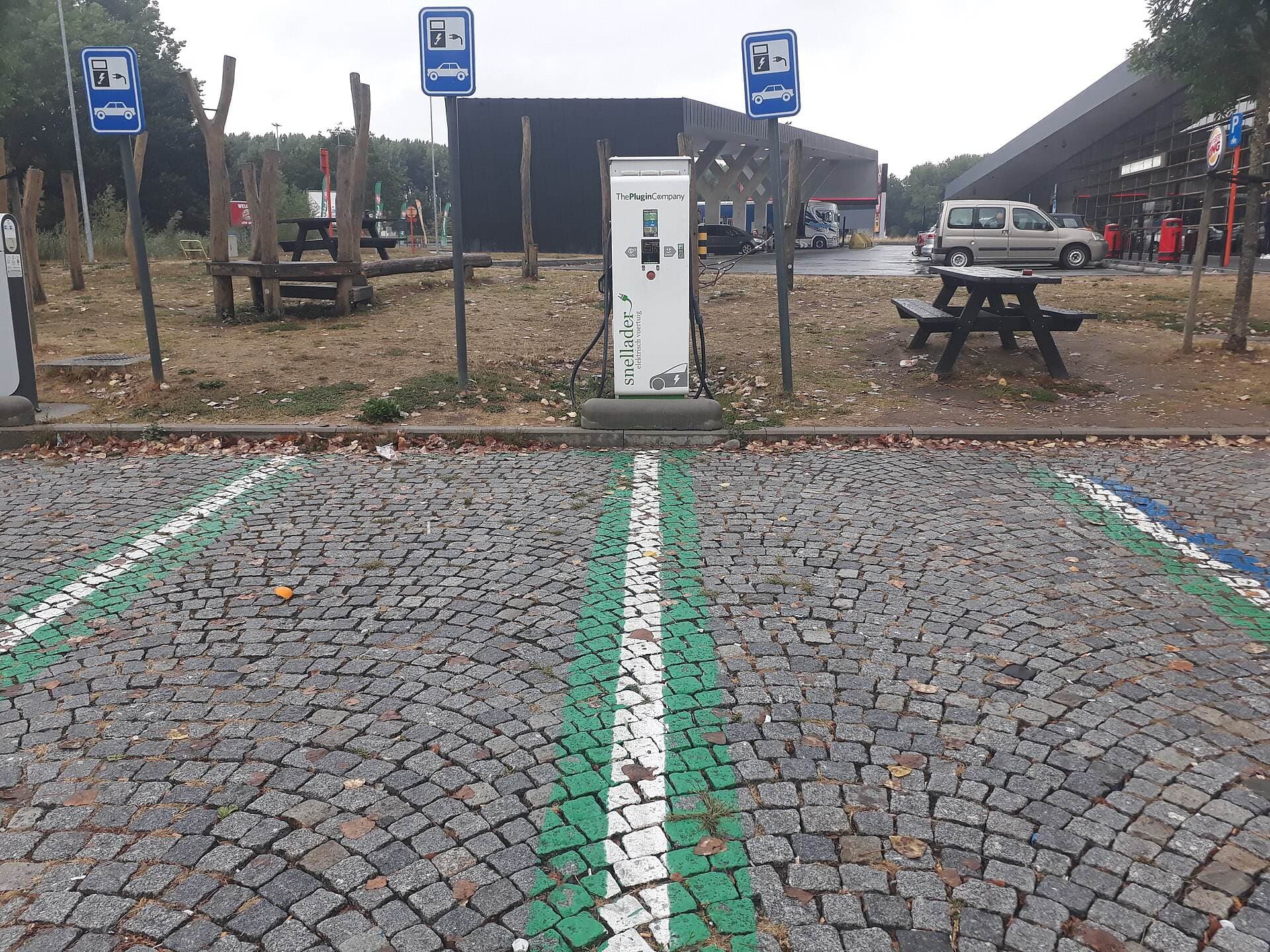
Photo: Aschroet (CC0)
Travel
Driving an Electric Car in Belgium: Charging, Payment and Prices
October 1, 2026
By Hugo Beignon, Founder of ma-borne-electrique.com
Plugs, paying without a Belgian account, what a fast charge costs and the mandatory low-emission zone registration: a practical guide to charging in Belgium.
Belgium had 126,045 public charging points at the end of June 2026, according to the EV Belgium federation, nearly 20,000 more than at the start of the year. The network is very dense in Flanders and catching up fast in Wallonia, and motorways are free. For a visitor, the trap is not charging but low-emission zone registration, which is required even for an electric car.
Your plug already fits
Belgium follows the European standard: the Type 2 connector for AC charging and the CCS2 combo connector for DC fast charging. Much of the network is AC chargers on streets and in car parks, often without a cable, so pack your own Type 2 cable.
How to pay without a Belgian account
The EU's AFIR regulation applies in Belgium: since April 2024, every new fast charger of 50 kW or more must accept bank cards, and existing fast chargers on the main European corridors must be fitted with readers before January 1, 2027. At older street chargers, payment goes through a QR code, an app or a charging card. Cards from neighboring countries often roam in Belgium, so check coverage before you leave.
What a charge costs in Belgium
Without a subscription, fast charging generally costs 0.60 to 0.80 euros per kWh in 2026 depending on the operator. At 0.70 euros per kWh, a compact EV using about 16 kWh per 100km costs around 11.20 euros per 100km. Subscriptions from the big networks bring the price down sharply if you charge often, and AC street chargers are usually cheaper than fast charging.
Low-emission zones: register, even with an EV
Brussels, Antwerp and Ghent each have a low-emission zone (LEZ). An electric car is allowed in, but a foreign-registered vehicle must be registered online, free of charge, on each city's register, or a fine applies. Each city runs its own register, so crossing all three means three registrations. Compliant Dutch cars are partly exempt. In Brussels, registration is valid for five years and can be done before entering the zone or within five days at the latest.
Finding a charger along your route
The map on ma-borne-electrique.com locates chargers in Belgium using Open Charge Map data, which can be incomplete. Check real-time availability in a route-planning app before you detour, especially in rural Wallonia, where the network is still less dense than in Flanders.
Checklist before you leave
- Check your connector (Type 2 or CCS2) and pack your Type 2 cable.
- Register your car on the Brussels, Antwerp and Ghent LEZ registers if you will pass through them.
- Keep a bank card handy and a charging app as a backup.
- For a stay of several days, compare the big fast-charging networks' subscriptions.
- On fast chargers, aim for 20% to 80%: charging speed drops beyond that.
Frequently asked questions
Does a foreign electric car need to register for Belgian LEZs?
Yes. In Brussels, Antwerp and Ghent, a foreign-registered vehicle must be registered online, free of charge, even if it is electric. Each city has its own register, and forgetting can lead to a fine.
Can I pay by bank card at Belgian chargers?
Yes at recent fast chargers: since April 2024, new chargers of 50 kW or more must accept cards, and fast chargers on the main European corridors must be fitted with readers before January 1, 2027. At street chargers, expect an app or a QR code.
How much does fast charging cost in Belgium?
Without a subscription, generally 0.60 to 0.80 euros per kWh in 2026 depending on the operator, around 11.20 euros per 100km for a compact EV at 0.70 euros per kWh.
Are Belgian motorways tolled?
Not for cars: Belgian motorways are free, electric or not. Only the Liefkenshoek tunnel in Antwerp charges a toll.
Read also
- Driving an Electric Car in France: Charging, Cards and Prices
- Driving an Electric Car in Germany: Charging, Payment and Prices
- Driving an Electric Car in the UK: Charging, Payment and Prices
- Driving an Electric Car in Switzerland: Charging, Vignette and Prices
- Driving an Electric Car in Spain: Charging, Payment and Prices
- EV Charging Cards in Europe: Which One to Choose in 2026?
- Charging stations by region: station counts, fast charging and best-covered towns
- EV charging guide by model: power, times and costs (Tesla, Renault, Peugeot...)
- National EV charging barometer: reliability and uptime by network
Want to find a charging station nearby? Check the charging map to plan your next trip.