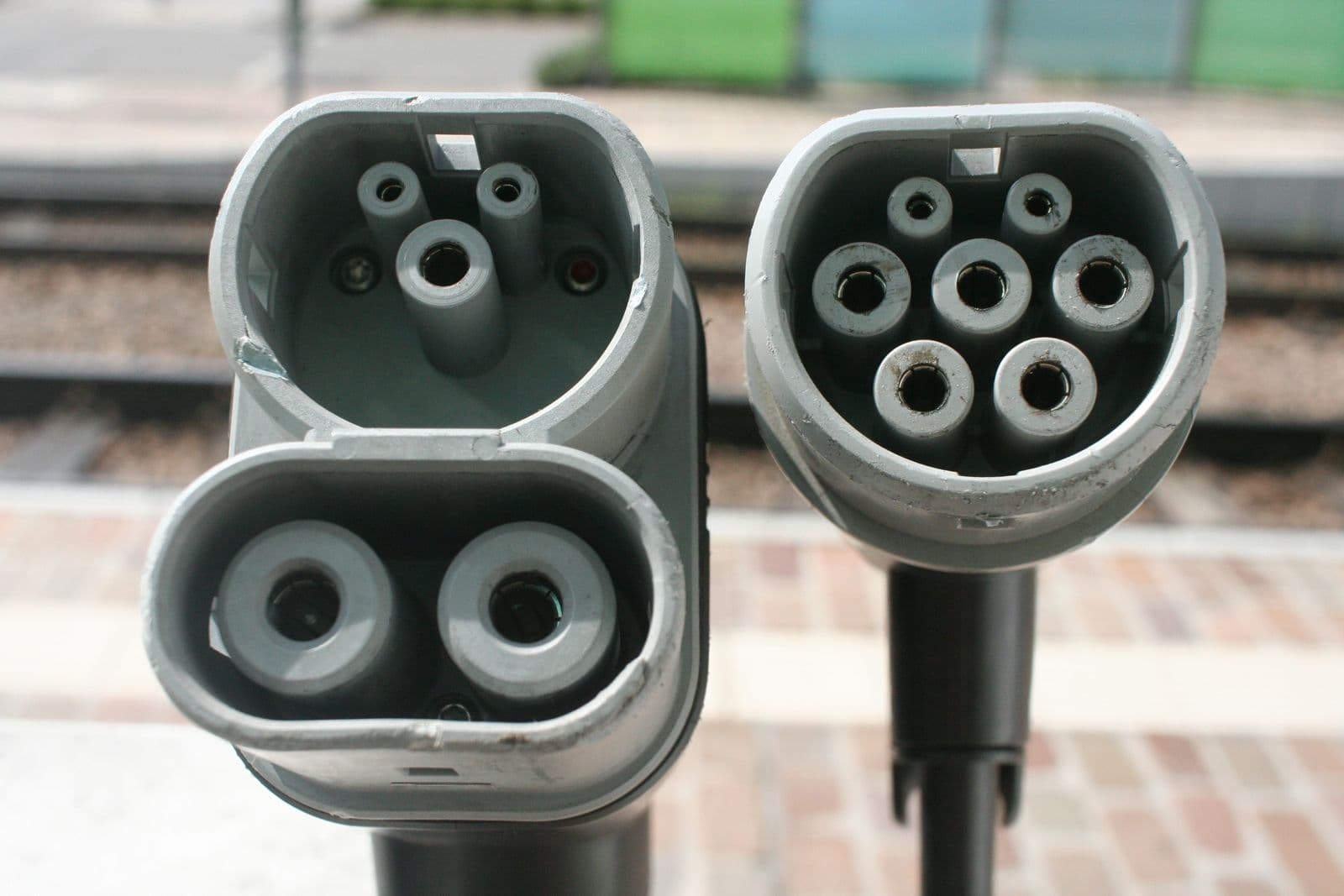
Photo: Paul Sladen (CC0 1.0)
Understanding Charging
AC vs DC Charging: What's the Difference, and Which Do You Need?
September 15, 2026
By Hugo Beignon, Founder of ma-borne-electrique.com
Alternating current versus direct current, onboard converter versus charging the battery directly: what actually separates a slow charge from a fast one, wherever you drive.
AC, DC, a kW number posted on the charger that never quite matches the speed you actually get: these terms show up everywhere once you start looking into EV charging, without always being explained clearly. Understanding the difference mostly helps avoid two common mistakes, paying for a charger more powerful than your car can use, or being surprised that a charge takes far longer than expected.
Alternating current (AC): everyday charging
A home outlet, a wallbox at home or at work, most parking lot chargers all deliver alternating current. That current can't fill the battery directly, since batteries store energy as direct current: it first passes through the car's onboard charger, an electronic unit that converts it. That onboard charger, not the charging station, is what caps the power actually received, usually somewhere between 3.7 and 22 kW depending on the vehicle.
Direct current (DC): fast charging on the road
At a fast or ultra-fast charger, at a service station or along a highway, direct current is produced by the charger itself and sent straight into the battery, skipping the onboard charger entirely. That skipped conversion step, combined with much higher power levels, typically 50 to over 350 kW, is why a DC charge takes minutes where an AC charge takes hours.
Why the number on the charger isn't always the speed you get
A 22 kW AC charger won't do anything more than a 7 kW one if the car only accepts 7 kW of AC power, a limit that's specific to each model and listed in its spec sheet. On the DC side, the maximum power a battery can absorb also drops as the charge level rises, which is why speed slows down noticeably past 80%.
Which connector carries which current
The Type 2 connector is the European standard for alternating current. The CCS Combo connector adds two extra pins to a Type 2 to also carry direct current, so a single CCS Combo port can usually handle both. CHAdeMO, originally from Japan, carries direct current only and is gradually becoming less common on new vehicles.
Which one to use, depending on the situation
- Charging at home or at work over several hours, overnight or during the workday: alternating current.
- Charging on the highway in the middle of a long trip, in 20 to 40 minutes: fast direct current.
- Charging while running errands or on a short break, depending on what the parking lot offers: AC or DC, whichever is available.
- Before installing a home charger, check the maximum AC power your car actually accepts so you don't pay for a station it can't fully use.
A distinction that doesn't depend on any market
Whether the charging network is French, German, Spanish, or North American, the same logic applies everywhere, only the physical connectors differ from one region to another. Understanding AC versus DC mostly helps in picking the right type of charger for the trip at hand, rather than relying on the kW number alone.
Frequently asked questions
What's the difference between AC and DC charging?
Alternating current (AC) passes through the car's onboard charger before reaching the battery, which limits its speed. Direct current (DC) goes straight into the battery without that step, allowing much higher power levels and a far faster charge.
Why does my car charge slower than the power shown on the charger?
With AC, it's the car's onboard charger that caps the power actually received, not the station. With DC, the maximum power the battery can absorb drops as the charge level rises, which is why speed slows down noticeably past 80%.
Does DC charging wear out the battery faster than AC?
Relying exclusively and repeatedly on fast DC charging can slightly speed up battery wear compared to daily AC charging, but the impact stays limited as long as you avoid routinely charging all the way to 100%.
Which connector should I look for, Type 2 or CCS Combo?
Type 2 carries alternating current only. CCS Combo adds two pins to a Type 2 to also carry direct current, so a single CCS Combo port generally handles both types of charging.
Want to find a charging station nearby? Check the charging map to plan your next trip.